EGP 12,750Mental Health & WellbeingCertificate, valid 12 months
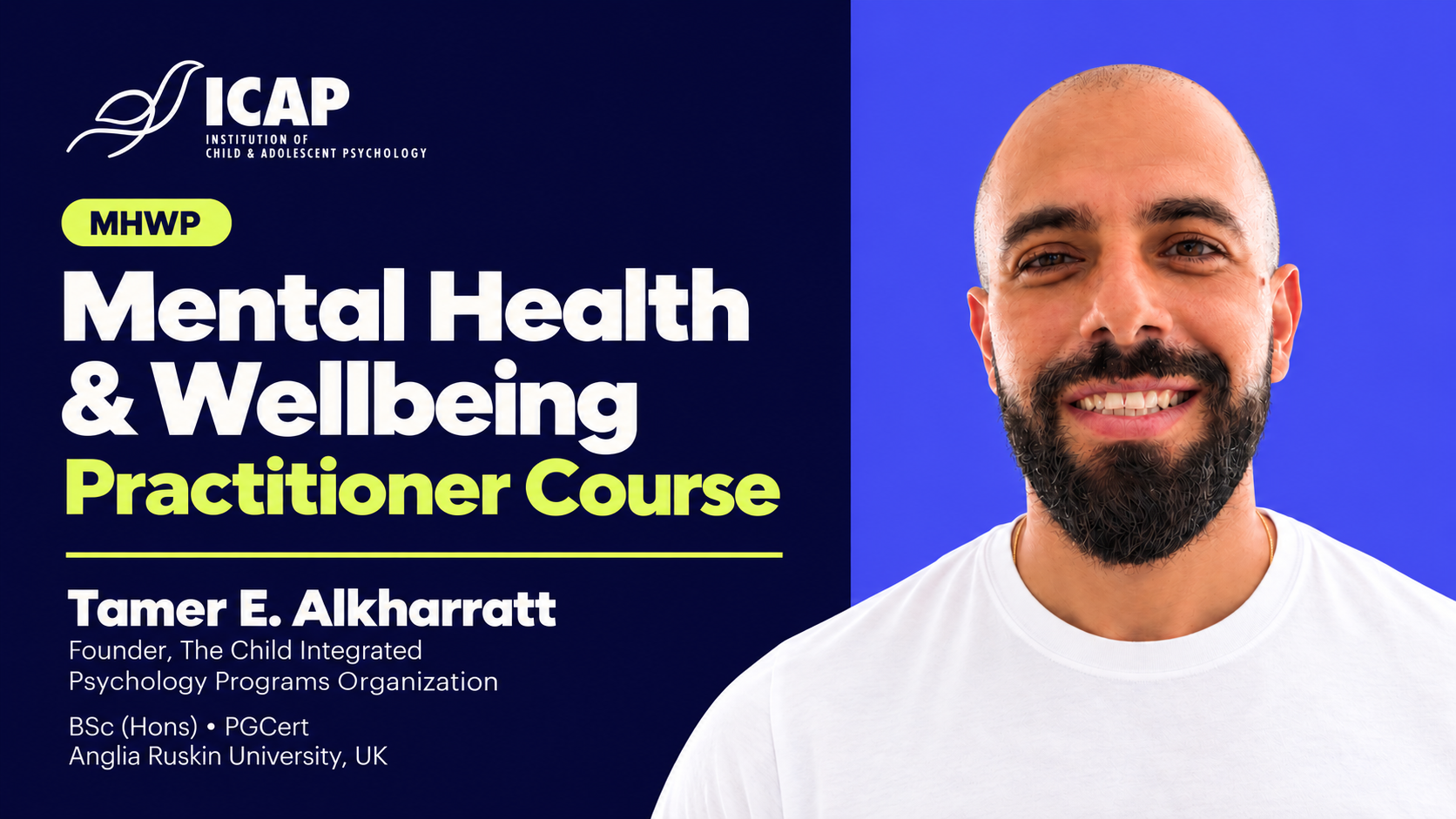
Mental Health Psychosocial Practitioner (MHWP) Certification
A Guiding Framework for Child and Adolescent Wellbeing Practitioners
- Format
- Self-paced
- Level
- Intermediate
- Length
- 40 hours
- Language
- English
What you will be able to do
- Define the scope, ethics, and professional boundaries of the Mental Health & Wellbeing Practitioner (MHWP) role.
- Apply Irvin Yalom’s existential concerns to practitioner self-reflection and client empathy.
- Implement the THRIVE framework (Trust, Healing, Relate, Individualise, Validate, Empower) in clinical sessions.
- Utilise the Neurosequential Model (Regulate-Relate-Reason) and Polyvagal Theory to support emotional regulation.
- Design neurodiverse-affirmative, specific, measurable, and observable (SMO) goals using Goal Attainment Scaling.
- Demonstrate effective validation and empowerment techniques rooted in Self-Psychology and Winnicott’s theories.
About this course
This comprehensive course equips Mental Health & Wellbeing Practitioners (MHWPs) with the theoretical foundations and practical tools necessary to implement evidence-based interventions for children and adolescents. Rooted in the proprietary THRIVE framework (Trust, Healing, Relate, Individualised, Validate, Empower), the curriculum bridges the gap between psychological theory and clinical practice. Practitioners will explore existential concerns, neurosequential models, and polyvagal theory to better understand the internal worlds of the youth they support. Throughout five detailed modules, learners will master the 'Regulate-Relate-Reason' sequence, develop neurodiverse-affirmative goal-setting skills using Goal Attainment Scaling (GAS), and refine their capacity for therapeutic validation. The course emphasises the practitioner's self-awareness, challenging 'contingency thinking' and promoting a reflective stance through Yalom’s existential framework. By the end of this programme, graduates will be prepared to navigate the ethical boundaries of the MHWP role while delivering high-impact, relational support in early intervention settings.
Syllabus
7 modules — 1 lesson free to preview
Foundations of the MHWP Role and Self-Awareness
- Welcome to the course (free preview) Reading
Healing, Regulation, and the Nervous System
Lesson titles for this module are shown after enrolment.
Relational Health and Mindsight
Lesson titles for this module are shown after enrolment.
Goal Setting and Goal Attainment Scaling (GAS)
Lesson titles for this module are shown after enrolment.
Validation, Empowerment, and Professional Standards
Lesson titles for this module are shown after enrolment.
Final assessment
Lesson titles for this module are shown after enrolment.
Additional resources
Lesson titles for this module are shown after enrolment.
Questions
How is this different from traditional clinical psychology?
While it draws on CBT, DBT, and ACT principles, the MHWP role is a practical, evidence-based alternative focused on early intervention and relational health rather than long-term intensive psychotherapy or diagnosis.
Can I diagnose patients after this course?
MHWPs are practitioners who work within a specific scope. This course outlines the Level 1 and Level 2 certification requirements, including the strict prohibition on providing clinical diagnoses.
Does this course cover neurodiversity?
Yes, the course covers neurodiverse-affirmative practices, specifically in Module 4, regarding goal setting and the Goal Attainment Scaling (GAS) system.
Who is this course for?
Psychology Graduates transitioning into support roles or early intervention practitioners.
What do I need before I start?
A Bachelor’s degree in Psychology or a related field. Basic understanding of child development and cognitive-behavioural principles.
More programs
- Applied Professional Reasoning
Interpreting Complex Situations & Deciding What to Do Next
- Social-Emotional Learning (SEL): Foundations, Facilitation & Applied Practice
Evidence-informed, neurodiversity-affirming instruction and facilitation for multidisciplinary practitioners.
- 1:1 Session Delivery: Foundations, Professional Standards & Practice
Master the foundational principles, professional standards, and applied reasoning required to facilitate impactful, neurodiversity-affirming 1:1 sessions.